Newcore is a finalist for the 2024 EG Awards
category
Awards, News
date
July 2, 2024
We are pleased to be a finalist for the 2024 EG Awards in the Alternatives Specialist category.
View the shortlist here.
We look forward to the results!
category
Awards, News
date
July 2, 2024
We are pleased to be a finalist for the 2024 EG Awards in the Alternatives Specialist category.
View the shortlist here.
We look forward to the results!
category
Featured, News
date
July 1, 2024
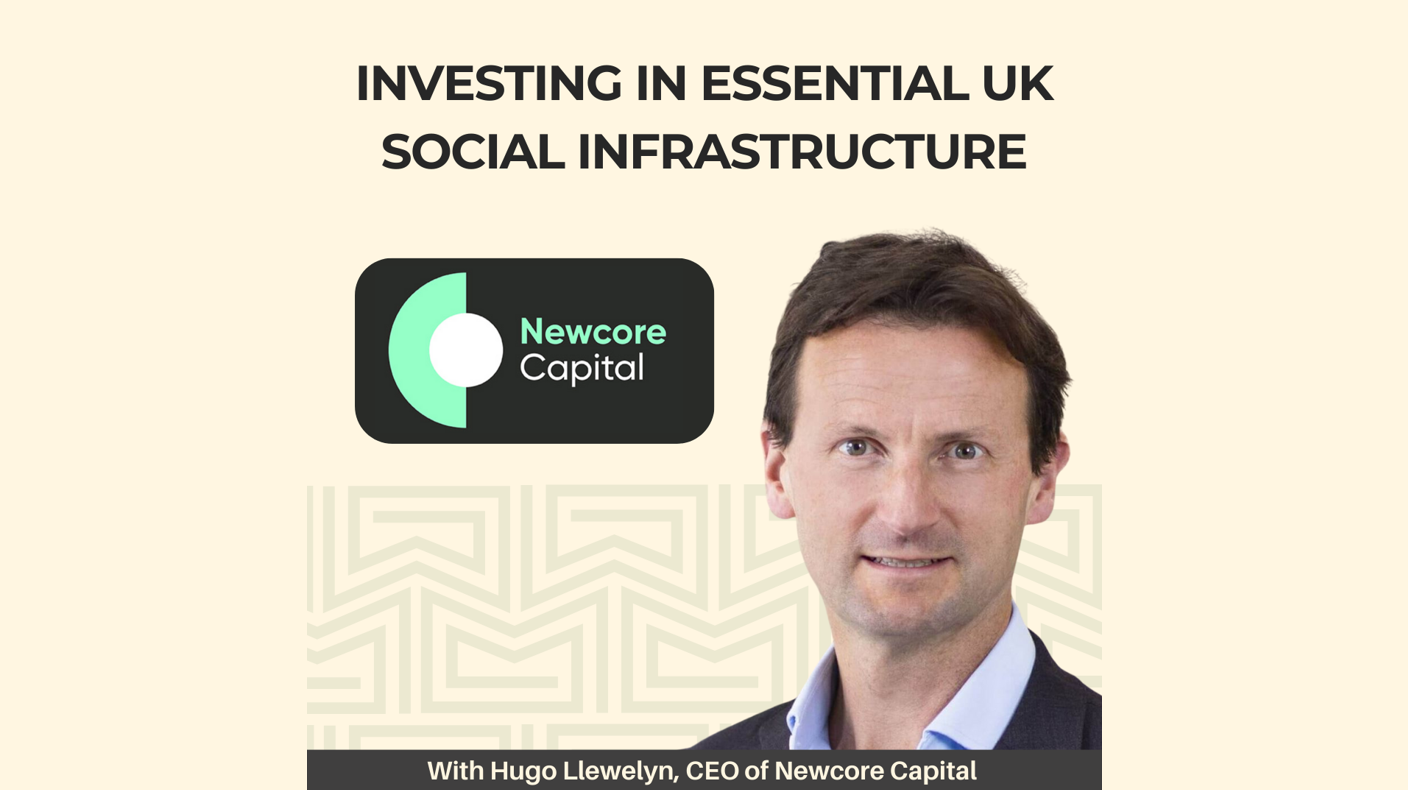
Thank you to Infrastructure Investor for publishing Hugo’s piece on private equity infrastructure and the need for a different approach to managing core assets in the sector.
Stewardship of functional assets core to the UK’s social and economic infrastructure needs to be low-levered, lower paid (no carried interest to managers for core risk: we’ll leave it to Ludovic Phalippou to work out the amounts earned on this example in the past) and run for the long term, with clearly accepted principles of capital expenditure from operating cashflow (or within the context of that low leverage).
Read the full article below.
If there is one key lesson to take away from the Thames Water debacle, it is that private equity managers focused on real assets and infrastructure, and the investors who back them, will need a three-dimensional understanding of sustainability – social, environmental, of course but crucially, financial – to navigate the coming cycle.
Given we are in the business of managing other people’s money, this may seem blindingly obvious, but quantitative easing and ultra-low interest rates warped industry perception of risk. From 2010 to 2022, there was easy, short-term money to be made by fund managers using low-priced credit to lever businesses, infrastructure and real estate. This was true right up until the LDI-driven interest rate shock of September 2022, which coincided with the first proposed quantitative tightening and a bond market nervous about geopolitical affairs.
If you bought into, then sold your assets before Q4 2022 (and didn’t reinvest), you were in the money. Most haven’t. If you reinvested pre-2022 into assets stapled to those high levels of leverage – retained now post-2022 – I would politely suggest that your original equity investment is now significantly impaired in almost all cases.
Directors’ valuations of private, illiquid portfolios might slow the coming car crash, but the liquidity crunch in the private equity markets is a clear signpost it has already happened. Many managers are now hoping for a return to a low interest rate environment. However, the chances of interest rates falling to levels where another asset boom occurs are minimal, given there is significant quantitative tightening (the reversing of QE) to come and inflationary drivers cannot be controlled within domestic borders anymore. Looking over the long term, interest rates at around the 5 percent mark are within normal levels.
The pricing of government bonds is central to this story, as gilts provide the starting reference rate for UK risk assets. This meant that, when gilt rates were artificially suppressed by the Bank of England, managers and investors were happy to accept much lower returns for risk assets, ignoring the temporary (and unsustainable) nature of that reference pricing rate. This was exacerbated at an equity level by high leverage.
Large-scale capital allocations in the past decade kept flowing to managers promising 2-3x returns on equity because they were using 60 percent to 80 percent LTV – or in private equity/equity infrastructure terms, 6-8x EBITDA debt multiples to increase unlevered returns.
The high debt load though, given amortisation and interest payments, did not just increase the volatility of the investment. It also essentially stripped UK Assetco during this time of the cash required for capital expenditure needed to improve assets and businesses, particularly from an environmental standpoint. If capital expenditure was made, this generally came from increasing borrowings.
Government did not regulate private equity markets in the last cycle in relation to risk. Regulators linked to water and other infrastructure sectors struggled to control the behaviour of private equity-led consortia running infrastructure, for example, our water industry, most particularly failing to enshrine sensible levels of debt (perhaps 30 percent not 80 percent of regulated assets) stressed for high interest rates (eg, 10 percent) and compulsory capital expenditure.
Thames Water, for example, a business that was generating perhaps £1 billion ($1.26 billion; €1.18 billion) per annum of cash during this time, should be a sound long-term asset in private hands – if, say, one-third of the cashflow was used for capital expenditure, a third for distributions and the rest retained for working capital purposes and future proofing environmentally. If this was bound legally and, therefore, enforceable, the operational business might then have a value of £6 billion to £7 billion – 20x distributable cashflow, say – and act as a lower risk equity infrastructure asset looking after all its stakeholders.
In summary, asset stewardship of assets core to the UK’s social and economic infrastructure needs to be low-levered, lower paid (no carried interest to managers for core risk) and run for the long term, with clearly accepted principles of capital expenditure from operating cashflow (or within the context of that low leverage). More and more institutional investors are waking up to this reality and to what defines a truly sustainable fund management service. This will hopefully dictate where capital will flow for the next decade.
Hugo Llewelyn is the founder and chief executive of Newcore Capital, a UK specialist investor in social infrastructure real estate.

category
Awards, News
date
July 1, 2024
We are pleased that Newcore has been shortlisted as one of the 10 finalists for the 2024 GRI Awards Europe. Please vote for us in the Impacting Investor of the Year category below.
Link here – GRI Awards Europe 2024 (griclub.org)
We look forward to the results!
category
News
date
May 22, 2024
Newcore Capital, a UK-focussed real estate investment manager specialising in social infrastructure, has appointed Charles Weeks, previously Head of Real Estate for Europe and APAC at Barings, as a Senior Advisor.
Weeks will be advising Hugo Llewelyn, CEO, and the senior Newcore Capital team, on the further development and expansion of the Newcore business, with a focus on expanding the manager’s investor base and partnerships.
Weeks, who retired earlier this year, and Hugo Llewelyn, CEO of Newcore Capital, co-founded Protego Real Estate Investors in 2004. Together they successfully established and built the UK and European investment management business, which was acquired by Barings (then Cornerstone) in 2010. Weeks remained at Barings to continue to lead the growth of the Barings real estate enterprise in Europe, and later into APAC, while Llewelyn departed to start Newcore Capital.
Charles Weeks, Senior Advisor: “It’s exciting to be reunited with Hugo and be working with his senior team in supporting the further development and growth of Newcore Capital. Newcore has already established a strong reputation in the real estate industry, thanks to their unique investment focus and emphasis on sustainability – environmental, social and financial – as well as the solid investment returns they have delivered for their institutional clients, despite the challenging market conditions we have seen witnessed in recent times”.
Newcore Capital is a specialist Alternatives Manager, focused on social infrastructure real estate. A typical investment would be an asset leased to service providers in the Education and Healthcare sectors. It is a Certified B Corp business and was recently rated the highest scoring real assets fund manager in the movement globally.
Newcore adopts a place-based investment strategy of turning disused or inefficient assets into real estate that serves socially productive uses with benefit to local environments. Target social infrastructure sub-sectors include clinical healthcare, education and childcare, storage, waste management, and transport.
In late 2023, Newcore announced the launch of a new core-plus investment vehicle, named The Newcore Social Infrastructure Income Fund, which is targeting £375m in equity commitments. The vehicle – the firm’s largest fund yet – aims to capitalise the strong underlying demand fundamentals for social infrastructure real estate at a time of market dislocation, while its size is indicative of Newcore’s belief in the positive investment outlook for the sector.
Newcore also manages a value-add fund series, Newcore Strategic Situations (NSS), and last year closed the latest vehicle, NSS V, with £190m of equity.
The manager is led by CEO Hugo Llewelyn, COO Neil Sarkhel, CIO Harry Savory and Chairman Professor Andrew Baum.
Hugo Llewelyn, CEO of Newcore Capital: “Charles will play a pivotal role in our mission to achieve sustainable growth for our business in the decade ahead. Charles brings a wealth of experience from running the Barings European and APAC businesses; and is well-respected in the real estate investment industry. These attributes will help us to build on the success of the business to date as we seek to consolidate our market leading position in real estate investment providing essential services to society.”
category
Featured
date
May 2, 2024
i3 x Newcore Capital
Our CEO, Hugo Llewelyn recently contributed to Kali Persall’s article “Breaking the ice: After last year’s cooldown in infrastructure fundraising and deal flow, there are signs the market is thawing”, helping to shed light on the infrastructure fundraising environment.
In May 2023, Newcore announced a £190 million ($240 million) final close for its fifth U.K. social infrastructure real estate fund, Newcore Strategic Situations V and is on course for a first institutional close for its flagship core-plus vehicle, the Newcore Social Infrastructure Income Fund, in the next 3-6 months.
category
Awards, News
date
May 1, 2024
We are proud to be shortlisted for the Property Fund Manager of the year award at the 2024 Property Week Awards.
We look forward to the results in July.
category
Featured, News
date
April 19, 2024
Charlotte O’Leary, Pensions for Purpose CEO, and Kate Sandle, Newcore’s Director of Sustainability, discuss why the investment industry is crucial in creating the future we need.
During the conversation they discuss the history of business, the need for systems change, the importance of being a better business, engaging investors and asset owners, and proposed future legislation that ensures all stakeholder interests are considered.
Watch the full video here.
category
Article, News
date
March 28, 2024
Newcore Capital, the UK social infrastructure real estate specialist, has acquired a 5.6-acre supermarket investment in Bromley-by-Bow, East London, from British Land for £30m.
The site, which sits within the London Borough of Tower Hamlets, currently comprises a 70,000 sq ft Tesco supermarket, a 558-space car park, and a petrol filling station.
Morgan Williams and Osborne Clarke acted for British Land on the transaction. Savills and DWF acted for Newcore.
The asset was purchased on behalf of Newcore’s latest value-add vehicle, Newcore Strategic Situations (NSS V), as there is medium term scope to unlock value from the site due to its strategic location in a key regeneration area in East London, while benefitting in the shorter term from the income generated by the existing occupier.
NSS V reached a final close at £190m of equity commitments in May last year and is still in the investment phase. Recent acquisitions include an NHS-backed GP surgery in Kent, two education investments in Oxford and Cambridge, and a food distribution centre in Colchester.
Harry Savory, CIO, Newcore Capital, said: “We are pleased to have purchased the Tesco Bromley-by-Bow and we are actively on the hunt for further covered land plays in strategic locations where there is a medium-term opportunity to enhance value through increased provision of social infrastructure uses – this is a key criteria for us, alongside the potential for strong risk-adjusted returns”.
In late 2023, Newcore announced the launch of a new core-plus investment vehicle, named The Newcore Social Infrastructure Income Fund, which is targeting £375m in equity commitments. The vehicle – the firm’s largest fund yet – aims to capitalise the strong underlying demand fundamentals for social infrastructure real estate at a time of market dislocation, while its size is indicative of Newcore’s belief in the positive investment outlook for the sector.
Hugo Llewelyn, CEO, Newcore Capital, said: “With the deflationary impact of the internet continuing to disrupt offices and retail, previously the mainstay of institutional investment in real estate, investors are increasingly looking for exposure to asset classes that demonstrate resilience to technological change. We see the broad spectrum of social infrastructure as presenting one route for institutional capital seeking sustainable income and capital value growth and the ability to deliver tangible positive impact.”
category
Featured
date
March 25, 2024
BE News x Newcore Capital
B Corp early adopter Newcore Capital has just successfully re-certified to become the highest scoring real estate and infrastructure investment manager globally. To mark B Corp Month, Newcore contributed to a recent BE News article along with other B Corp certified companies on how – and why – they sought certification.
Read more here: To B Corp or not to B Corp, that is the question | BE News
category
Article, News
date
March 12, 2024
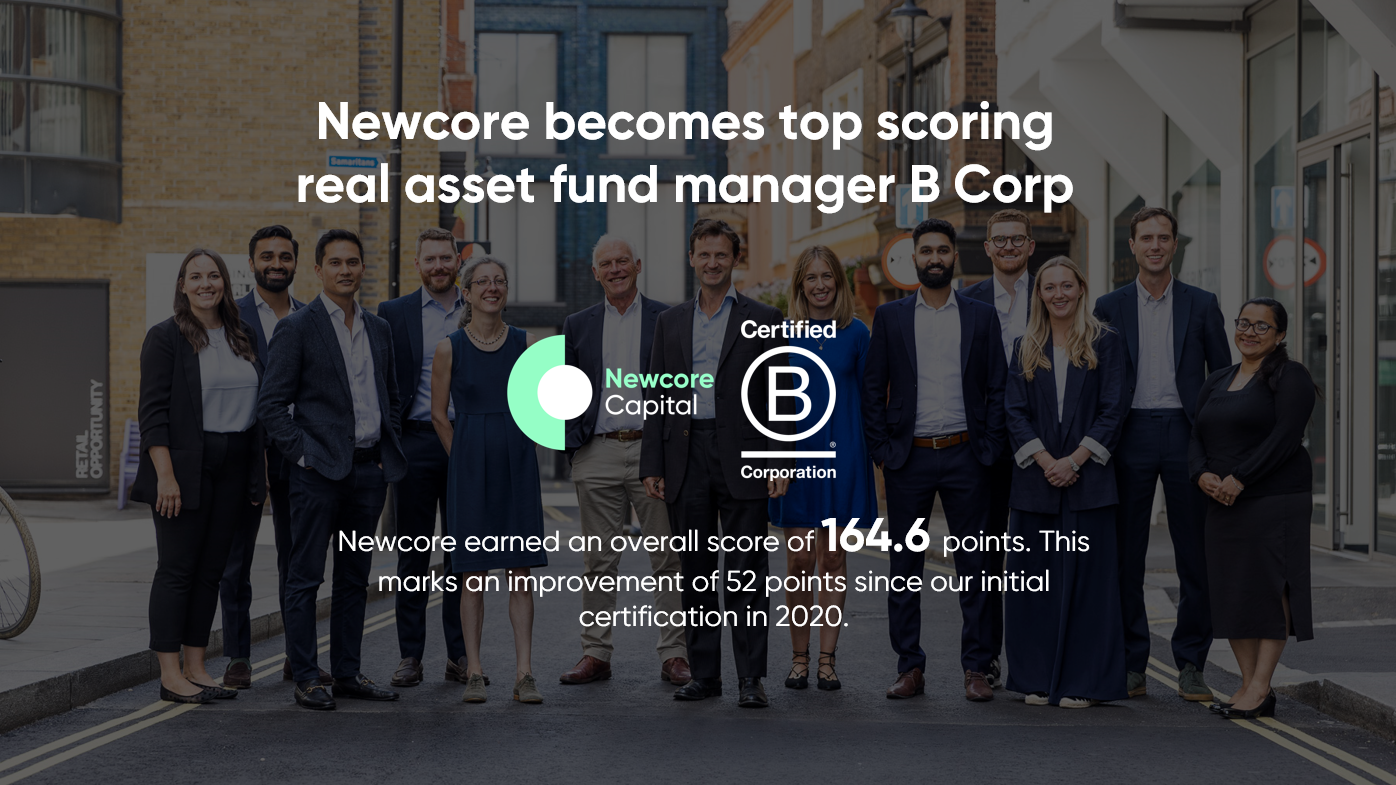
Newcore has successfully recertified as a B Corp with a score of 164.6 out of 200, making it the world’s highest scoring dedicated real asset fund manager. The score represents a 52-point increase from when Newcore first obtained certification at 112.6 in 2020.
The recertification also makes Newcore the third highest scoring company out of around 2000 UK-based B Corp businesses, and the fourth highest scoring financial services company worldwide.
The firm’s social and environmental performance improved in all five criteria on which B Corps are evaluated: governance, workers, community, environment, and customers.
B Corps are companies that have been independently verified by non-profit impact advisory firm B Lab to meet high standards of social and environmental performance, transparency, and accountability.
Firms must recertify for B Corp every three years to ensure that they maintain the standards required to be verified – a minimum score of 80 to be eligible for recertification – across their environmental and social performance.
Newcore adopts a place-based investment strategy of turning disused or inefficient assets into real estate that serves socially productive uses with benefit to local environments. Target social infrastructure sub-sectors for the firm include clinical healthcare, education and childcare, storage, waste management, and transport. The manager recently acquired its first GP surgery and plans to invest £100m in clinical healthcare over the next 2 years.
Kate Sandle, Director of Sustainability at Newcore Capital, said: “B Corp certification is – a notoriously rigorous and thorough process, so to re-certified with such an improved score is a testament to the work Newcore has put in to creating social impact and meeting high environmental standards over the last three years.
We look forward to continuing to improve in the future and working with B Lab and the B Corp community to encourage businesses to operate for the benefit of their broader stakeholders”
At the end of 2023 Newcore launched its latest core plus vehicle, the Newcore Social Infrastructure Income Fund (NSIIF), previously The Newcore Sustainable Income Trust, which is targeting a £350m equity raise. This followed a £190m final close for the latest vehicle in Newcore’s flagship value-add fund series, Newcore Strategic Situations V (NSS V). The manager’s B Corp status played a key role in the successful fundraise.
Hugo Llewelyn, CEO of Newcore Capital, said: “This is a very proud moment for Newcore. The business was conceived in 2011 with the conviction that there was a need for capital to be managed more responsibly and sustainably than the short-termist pre-2009 model. The team and I have worked very hard to ensure this principle has been integrated across all our operations.
“Social infrastructure makes a tangible, real difference to people’s everyday lives. Because of this, we believe it is particularly important for businesses working within the space to maintain high standards in relation to the environmental and social impact produced by their investments, and the score verifies that we have put this belief into practice.”